
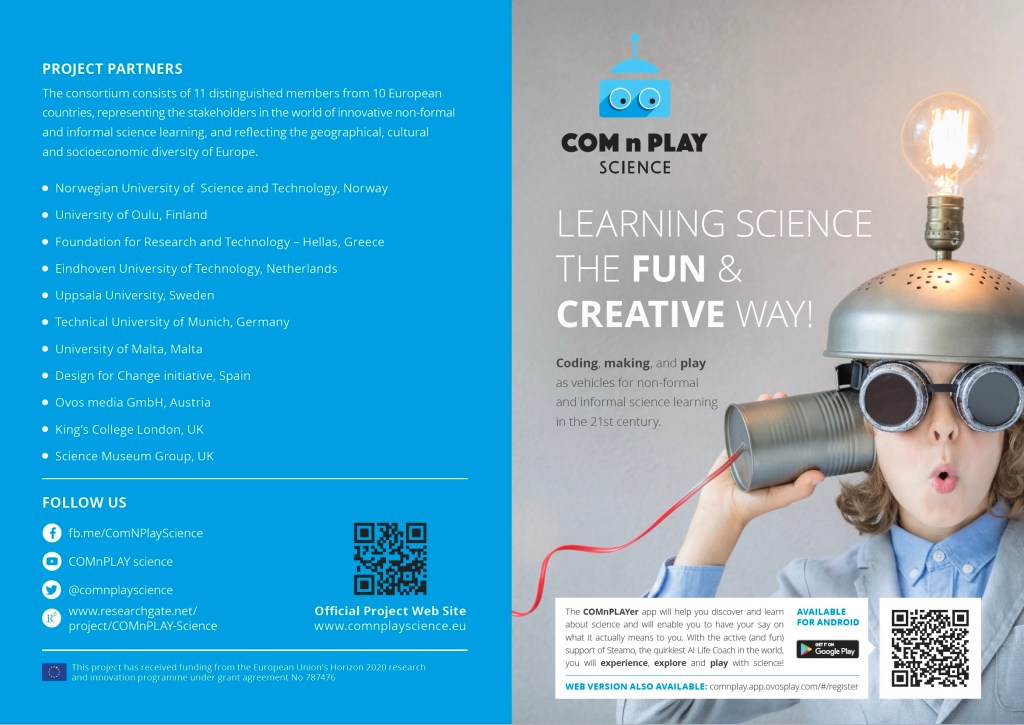
The Horizon EU funded COMnPLAY SCIENCE – project had 11 project partners from all around Europe. It sought to enhance Europe’s understanding of the emerging methods of informal science learning that young Europeans—children, adolescents, and young adults—are increasingly engaging in through coding, making, and play activities outside the traditional settings of school and higher education science classrooms, transcending the formal boundaries of science education., aiming to make learning science fun and creative.
I worked as a researcher in the project, and contributed to both carrying out data collection during case studies carried out by the university of Oulu research team, and compiling reports on the studies:
- Study 1 objective was to understand and characterize the nature of non-formal science education practices (particularly technology related) and the role fun plays within. Two case studies were conducted in clubs offering non-formal technology education in Oulu. The clubs were selected as they offer a rich and diverse sample: they are organized by two notable actors within technology education in Oulu as well as in Finland and they include diversity in the sense of activities offered for learners (robotics, programming). The exploratory study was carried out using qualitative research methods and some rudimentary quantitative analysis. Data was collected mostly through observation and interviews. Data analysis was qualitative in nature. The study reveals that non-formal technology education exist on a continuum of formal/non-formal/informal with the observed cases being clearly non-formal education with shades of the other types. Fun in these cases can be classified into three types: pedagogical fun (observed in e.g. when the teacher jokes with the students in a clear teacher-student relationship), fun in doing (when the materials and technologies used are fun, playing with the products of their labor and the feeling of success) and social fun (talk and laugh amongst peers, informal communication with instructors and pop culture references).
- Study 2 objective was to understand and characterize the nature of loosely structured non-formal science education through hands-on technology design and Making with intergenerational participants at a digital fabrication lab (called FabLab) in Oulu city center. In this study, parent-child participants (forming intergenerational groups) were invited to participate in a 7-week design and Making project at the city center FabLab as an afterschool activity twice a week. FabLab provides access to diverse range of digital fabrication devices and technology, including laser-cutter, 3D printers, vinyl cutter, and micro-electronics and e-textiles, together with trained instructors. The FabLab environment promotes Making and Maker culture, creating an ideal environment for this study. For each session, instructor-participant interactions were audio and video recorded, researchers made observations notes and took pictures. During the course of the study, participant-groups and instructors were interviewed to inquire about their science (and technology) capital. Data analysis was qualitative in nature. Through researcher observations and participants (adults and children) and instructor interviews, different (intrinsic and extrinsic) motivational and collaboration strategies were identified. The data-analysis revealed varied motivational and collaboration strategies across participant groups, influenced by roles and relationships. Instructors used approaches shaped by their experience, interpretation of project goals, and real-time problem-solving. Adult participants, often parents, adapted their strategies based on their technology expertise, their relationship with the child, and the child’s age, with younger children (7–8 years) often relying on adults to lead project design and implementation. Child participants’ motivation varied by age and group dynamics, with child-only groups displaying greater interaction and activity in FabLab spaces compared to child-adult groups, which were typically family-based. Intergroup interactions increased over time as participants grew comfortable, with children using breaks for socializing and shared play, highlighting the sessions’ role as both a learning and social environment.
The reports were published on the project website, and used to help prepare deliverables reporting e.g. an inventory of practices and core learnings.
 Heidi Hartikainen